
Half-Digested Statistics
There are a great many misuses of statistics. People feel mistrustful of statistics because they involve numbers and thus mathematics. If you don't understand the numbers you are, perhaps, right to shy away from them. And we have all heard about statistics and damn lies and have come to believe that you can prove almost anything with stats. So any organisation that uses stats to draw conclusions or make recommendations ought to be careful and make sure they get the numbers right, don't frighten off people and present the data correctly.

It is thus sad to see that the Consumers Association in their magazine Which? is not always as careful as one would hope such a responsible body should be. Let's take the case of carrots. In the June 2010 Which? there is a piece comparing the price of prepared carrots (washed and sliced and packed) versus loose carrots. It quotes the per kilogram price of prepared and loose carrots from Sainsbury, Morrison, Tesco and Asda supermarkets and concludes that you could be paying up to three times as much for the prepared carrots as loose ones in the store with the greatest difference (Sainsbury). But they have forgotten that part of the weight of the loose carrots are the green tops which most of us don't eat. To make a proper comparison, we should allow for the fact that one kg of loose carrots dose not give us one kg of edible orange veg. By looking at carrots from my garden, it seems that a typical figure might be that 200g of each kg of loose carrots is green top so you would need to buy 1.25kg of loose carrots to get one kg of edible root. This reduces the cost factor of prepared to loose carrots from Sainsbury from 3.3 times to 2.7 times.
OK, this is a small change but for an organisation that has cupboards full of statisticians and market evaluators, it really should present the whole story. Then there is the case of water meters and how much they may or may not save households across the country. The August 2010 issue of Which? carries an article called The Future of Water Charges which aims to show how bills for water and sewage vary by water supply company for metered and unmetered households. And boy, is there an amazing difference between the cheapest and the most expensive! The average unmetered bill for the area covered by each company ranges from £255 for Thames Water to £511 for South West Water - a difference of £256. Before we all move to the Thames Valley it might be worth asking if the difference is due solely to the Company's charges and costs, or is it that the people of London take few baths and use disposable plates and cups. I think Which? deprecates this large difference but offers no considered analysis and is content to let the reader walk away with the idea the SW Water is a rapacious and greedy company. More about this in a moment.
The article includes a table headed Do You Need A Meter? For eleven water companies the table compares the bill with a meter for households of one, two, three or four people with the average unmetered bill for that water company. I show an extract from the table for the first company, Anglian Water.
| one person | four people | |||
| average unmetered bill | cost with meter | saving | cost with meter | saving |
| £363 | £254 | £109 | £389 | -£26 |
The conclusion is obvious - the smaller the family, the more it saves by being metered. But there are some inconsistencies with the concept of "Average Unmetered Bill For the Respective Water Company" here. Below I show extracted data from the table for Scottish Water (top row) and for South West Water (bottom row).
| £280 | £546 | -£266 | £650 | -£370 |
| £511 | £284 | £227 | £439 | £72 |
In Scotland the average family must consist of about half a person whilst in the South West area the average family must be upwards of five. Hmmm. And three paragraphs above I used the table to show the average unmetered bill was cheapest for Thames Water but dearest for South West but if we look at what the metered costs would be the situation changes - Thames is still cheapest but Scottish now becomes the dearest when its average unmetered rating was fourth equal. Hmmm again. How could this slip through? Something more needs to be said about water costs.

Sorry to be so "picky" Which?, but you have to set the best standards or else sloppy work will lead to critics dismissing what you say.
Now, let's keep an eye open for other slops and, more importantly, cases where it seems authors have deliberately used statistics to mislead. Examples welcome at my email.
BOOKS & RELATED STUFF
The First Modern Bookseller
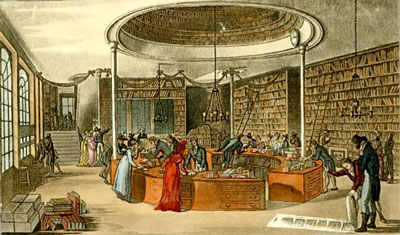
If you say "bookseller" I guess one now thinks about Amazon, Barnes & Noble or Waterstone. But towards the end of the eighteenth century booksellers, though still acting as publishers, were beginning to concentrate on selling. And James Lackington was eventually the biggest: he adopted a no-credit, cash-only, policy and sold at the lowest price possible. This made him enemies with other London booksellers but his main idea, what we would call "stack'em high and sell'em cheap," worked. His shop was enormous and had 200,000 volumes on sale at any one time: in 1791 he made £4000 profit (equivalent to £4 million or more today). The picture shows the ground floor main counter and an author checking his proofs.
An account of Lackington's colourful life, taken from the 1865 book by Charles Knight, is here (1.8 MB).
The Amateur Printer Who
Changed the Business
John Baskerville came from Birmingham at a time when this great city was at the centre of industrial trade and innovation. His story is told, not always coherently, on many web sites so it need not be repeated here. However, one site with a local view is at:
http://bobmiles.bulldoghome.com/pages/ bobmiles_bulldoghome_com/morejbask.htm
and another from Birmingham with sn entertaining video is at:
http://www.birminghamuk.com/johnbaskerville.htm
and there are several books and biographies, not all readily available. One account of Baskerville's life, if you can find it, is in Raymond Lister's fascinating book of short lives of Great Craftsmen and the relevant chapter, number five, is available here as a PDF (140kB)
For a Five-Year-Old
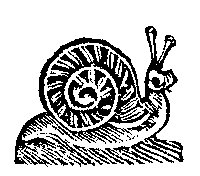
A snail is climbing up the window-sill
into your room, after a night of rain.
You call me in to see, and I explain
that it would be unkind to leave it there:
it might crawl to the floor; we must take care
that no one squashes it. You understand,
and carry it outside, with careful hand,
to eat a daffodil.
I see, then, that a kind of faith prevails:
your gentleness is moulded still by words
from me, who have trapped mice and shot wild birds,
from me, who drowned your kittens, who betrayed
your closest relatives, and who purveyed
the harshest kind of truth to many another.
But that is how things are: I am your mother,
And we are kind to snails.
Fleur Adcock
from Poems 1960-2000
At present, Adam and Eve are just "place-holding".
© 2009-2026 John Mellerio